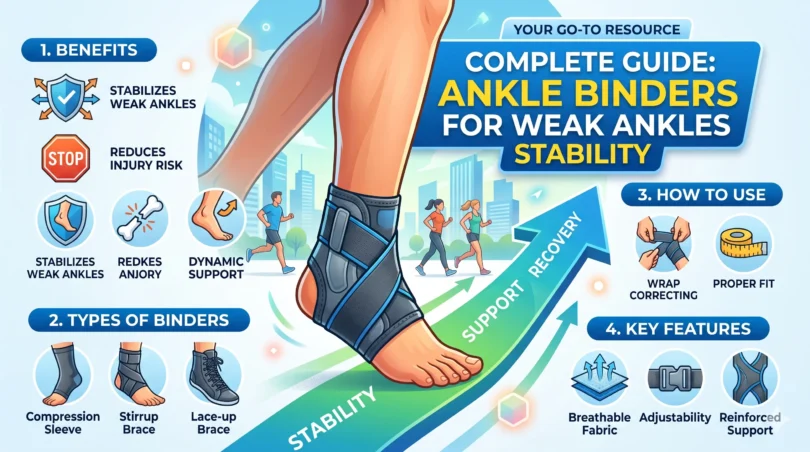

Ever walked with difficulty after your foot bent the wrong way or was unlucky enough to sprain your ankle while jogging? These are the moments that really remind us of the flexibility of our bodies, but also the need for proper care as well as support in recovery. Ankle injuries are the most experienced injuries. Ankles are under constant strain from sports like football, badminton or cricket. Accidental slips on wet surfaces or prolonged standing at work can cause extra pressure over the ankles.
Repeated stress can make you experience pain, weakness or long term discomfort. In such cases, an ankle binder can offer required support and stability. It helps to reduce strain that ultimately speeds up recovery. An ankle binder is a perfect example of help required at this time. It is a multi-purpose healing device that provides support at the injury site.
In this blog we will have a closer look at what ankle binders are used for. Also, how they can help in different situations.
What Are Ankle Binders?
Ankle binders are supportive devices designed to wrap around the ankle. It provides support to the injured area. It is made to hug the contours of your ankle, immobilising the joint without causing discomfort. It is developed in such a way that it can be tightened or loosened as needed. It is preferred for immediate post injury relief.
Ankle Binder For Recovery From Sprained Ankle
A sprained ankle is a stretch of the ligaments that support the joint beyond their normal range. The result is pain, swelling and difficulty walking. This scenario involves an ankle binder which immobilises the ankle. This immobilisation is quite important as it limits movement to prevent further injury. This allows the ligaments to rest and heal. Moreover, the compression of an ankle binder helps to reduce swelling and increases blood flow to the injured area, both of which can significantly speed up the healing process.
Various Uses Of Ankle Binder
The ankle binder is a versatile item that should be used as a first aid device. Five scenarios where an ankle binder can be a game changer:
Ankle brace for sprained ankle: A sprain is an over stretch or tear of the ankle ligaments. Ankle binders can provide the required compression. It reduces the swelling as well as stabilizes the joint which ultimately speeds up healing.
Ankle brace for ankle sprain: A twisted ankle can lead to minor tearing as well as stretching of ligaments. An ankle binder supports the ankle in a stable position to decrease pain along with prevention of further injury.
Recovery from surgery: A binder can provide the support necessary in the early stages of recovery after surgery on the ankle. It helps to keep the ankle in restricted movement mode to enhance healing.
Preventive use in sports: Wearing an ankle binder during physical activities can give you extra support if you have weak ankles or injuries in the past. This can help you avoid possible injuries.
Mini-ankle wrap bandage for minor injuries: Minor injuries or discomfort can be managed by using an adjustable ankle bandage wrap. It offers customisable support as well as allows you to adjust the compression level. This helps to match the severity of the injury or the comfort level you need.
How To Use An Ankle Binder For Best Results?
An ankle binder must be properly applied to be effective. Here’s a step by step guide to ensure you are getting the best support:
Begin with a clean slate: Keeping the skin around your ankle clean and dry. This helps to avoid any skin irritation under the binder.
Set your foot: Keep your foot at a 90 degree angle to your leg. This is the natural and most stable position for your ankle.
Start to wrap up: Begin at the ball of your foot, wrapping the binder in overlapping layers. Distribute the support evenly by having each layer half the size of the layer below.
Ankle covers: Keep wrapping around to your ankle. When it reaches the ankle, run it around so that it makes a figure of eight around the ankle and under the foot. The method offers localized assistance to the affected area.
Tightness adjustment: The binder should be snug, but not too snug. You should be able to get a finger under the wrap. If it’s too tight, it may slow down blood circulation and therefore slow down the healing process.
Conclusion
Most ankle binder belts have a fastening mechanism such as Velcro. Make sure the end of the binder is secured so it doesn’t slip down or gets unwrapped. Ankle Braces are used to support and comfort your recovery in the best possible way. Ankle binders support you to full strength.
When used correctly an ankle support for running can be a valuable recovery and performance aid. It also helps to protect and reassure those runners who may have ankle weakness, instability or previous injury. But it should not replace targeted strengthening, balance and mobility exercises that build natural joint stability.