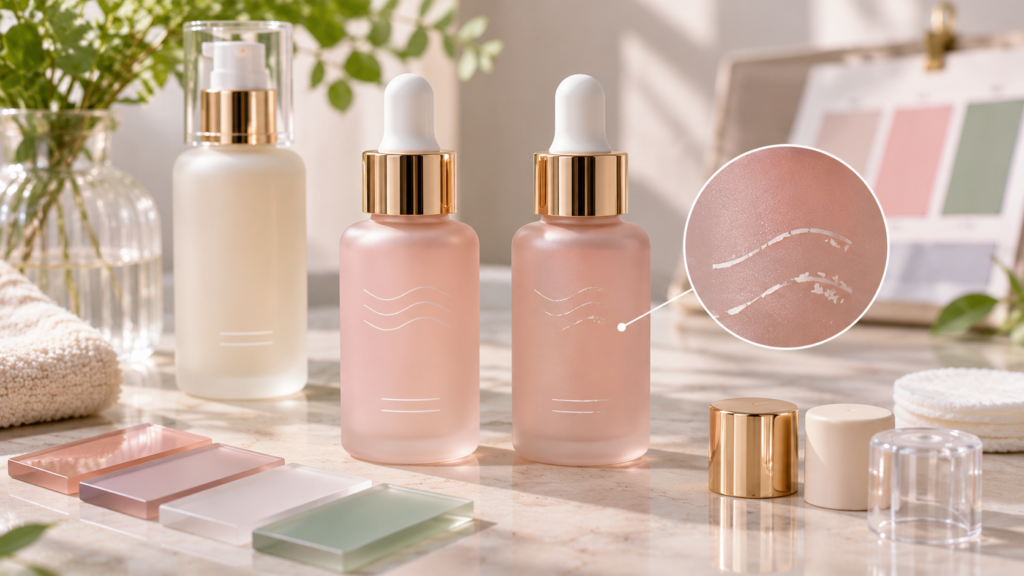
A customer buys a premium facial serum in a beautiful pink bottle. The white lettering is crisp, the finish feels refined, and the entire package looks carefully designed.
Four weeks later, part of the brand name has disappeared.
The serum may still work perfectly, but the bottle now looks noticeably worn. For a product marketed as premium skincare, that change can be disappointing.
This concern is not limited to imaginary examples. In online skincare discussions, some customers have reported printed lettering wearing off bottles after several weeks. Others say they have experienced no such problem with similar products.
These accounts do not prove a manufacturing defect or reveal the exact decoration process involved. They do, however, highlight a practical question for beauty brands:
If the packaging is meant to support a premium product experience, what should a brand change when its appearance deteriorates during normal use?
The answer is not simply to request “better printing.” First, the brand must identify what is wearing away. Then it can choose a suitable improvement, test that change under relevant conditions and approve a realistic standard for production.
1. First, Find Out What Is Actually Wearing Away
Imagine a skincare company developing a 30ml glass serum bottle with a rose-colored coating, white logo and metallic dropper collar.
After launch, several customers report that the white logo is disappearing.
The first response should be an investigation, not an immediate decision to change suppliers or switch printing technologies.
The brand should collect examples of the affected packaging and ask:
- Is only the white lettering disappearing, or is the pink color changing too?
- Is the damage concentrated where people grip the bottle?
- Does the affected area sit close to the dropper collar or cap?
- Was the bottle routinely kept on a bathroom shelf, or carried inside a bag?
- Did the change happen gradually, or after a particular cleaning or contact event?
These details help distinguish several possible problems.
If the logo disappears but the pink finish remains intact, the investigation should focus on the printed decoration and its interaction with the underlying surface.
If the pink coating is scratched or peeling, the coating system itself needs closer attention.
If damage appears around the bottle shoulder, the collar, cap or packing materials may be creating repeated contact.
If an applied label is lifting, its material, adhesive and contact surface should be evaluated separately.
A photograph may help identify the location of damage. It usually cannot prove the underlying cause.
The first improvement is therefore diagnostic: determine which layer is failing before changing the packaging specification.
2. Match the Solution to the Type of Damage
Different symptoms require different design decisions. Replacing one decoration method with another without understanding the problem can simply introduce a new set of risks.
Problem A: The Printed Logo Rubs Off
Start by checking the actual printing system, the surface beneath it and the location of the artwork.
A logo printed on a coated surface may behave differently from decoration applied to another approved substrate. Surface preparation, process conditions and contact during use can all be relevant.
Possible improvement routes include reviewing the printing and surface-treatment combination, changing the decoration method where technically appropriate, or moving the logo away from an area that experiences frequent rubbing.
For example, if most wear occurs where customers naturally hold the bottle, shifting a decorative mark to a less frequently touched position may reduce exposure. It does not automatically solve an unsuitable printing system, however.
The chosen change must be evaluated on the real finished bottle.
Problem B: A Colored Coating Becomes Scratched or Patchy
If the bottle’s color comes from a surface coating, inspect the coating rather than assuming the glass is defective.
The supplier and brand can review the proposed coating system, preparation and process conditions, and whether the finish suits the product’s expected handling.
A different approved coating route or a revised package design may be worth comparing.
In some projects, a suitable colored-glass option could also be considered, although color availability, appearance and structural requirements would need separate review.
No option should be described as automatically scratchproof.
Problem C: A Cap or Collar Repeatedly Rubs the Bottle
Changing the decoration may not address a mechanical contact problem.
Assemble the bottle using the intended dropper, collar and cap. Look for contact during opening, closing, packing and ordinary handling.
Depending on the findings, the improvement may involve adjusting the component configuration, reviewing tolerances, changing the decoration position or improving packing protection.
The complete assembly must then be checked again.
Problem D: The Applied Label Lifts or Peels
This is a separate packaging problem.
The brand should review the label construction, adhesive, actual glass surface, application conditions and expected exposure to moisture or product residue.
A suitable label material or a different placement may help, but switching from a label to direct printing is not automatically an improvement.
The correct choice depends on what the original failure involved.
3. A Practical Improvement Trial: Compare Two Real Samples
Return to the hypothetical pink serum bottle.
The brand suspects that repeated handling is contributing to the white logo wearing away. Instead of approving an entirely new design immediately, it asks the supplier to prepare two clearly documented versions.
Sample A: The existing bottle, finish and printed logo, used as the reference.
Sample B: The same bottle with a proposed change to the decoration system or logo location.
The brand keeps other variables as consistent as practical: bottle shape, closure, intended filling conditions and packaging configuration.
Now it can compare the alternatives rather than judging them from photographs.
A useful trial might include:
Repeated handling: Have representative users handle the complete bottle in ways that reflect ordinary use. Observe the areas they touch most frequently.
Formula contact: Where relevant, evaluate the effect of contact between the actual skincare formulation and the exterior decoration.
Component operation: Open and close the specified dropper assembly, checking for repeated contact with decorative areas.
Packing and transport: Review whether the carton, insert or nearby components create surface contact during intended distribution.
Cleaning exposure: Evaluate cleaning conditions that are reasonably expected for the product, rather than using arbitrary harsh chemicals.
The review should use agreed procedures, repeatable conditions and documented observations. The number of cycles, products used, inspection intervals and acceptance limits must be appropriate to the project.
A quick in-house comparison can help screen design options, but it is not a substitute for any formal testing required for commercial approval.
The important result is not merely that Sample B “looks better.”
It is whether the proposed change improves the observed problem without creating another unacceptable issue, such as poorer logo readability, an inconsistent color or an unsuitable component fit.
4. Define What “Improved” Actually Means
Packaging teams often use words such as durable, premium and long-lasting without defining them.
Those descriptions are not sufficient for a production specification.
Before approving a revised bottle, the brand and supplier should agree on what will be checked.
| Observed problem | Proposed change | Evidence needed before approval |
| Printed logo wears away | Review printing system or move artwork | Representative decorated samples and agreed handling or abrasion evaluation |
| Color coating scratches | Compare suitable finish options and exposure conditions | Coated samples evaluated under relevant contact conditions |
| Cap rubs against decoration | Review components or decoration placement | Repeated assembly and handling checks |
| Label edges lift | Review label construction, surface and application | Label evaluation on actual containers under intended conditions |
| Appearance varies between batches | Define a production reference and acceptance limits | Approved master samples, specifications and inspection records |
For each issue, the brand should record the original symptom, the suspected causes, the modification being evaluated and the agreed acceptance criteria.
An approval could specify that the brand name must remain legible after the defined evaluation, with no unacceptable visible loss of decoration.
But the meaning of “unacceptable” must be agreed in advance. It cannot be decided only after production goods arrive.
Coating tests can form part of this work. For example, ISO 2409:2020 describes a cross-cut procedure for assessing the resistance of certain paint coatings to separation from a substrate. It is not a direct measurement of adhesion strength, nor is it a general test of resistance to everyday rubbing.
The method is also not suitable for every coating type or thickness.
Therefore, a single favorable adhesion-related result should not be presented as proof that a printed cosmetic bottle will retain its appearance throughout normal use.
The evaluation must match the actual problem.
5. How FOLOVER PACK Can Support a Better Glass Packaging Decision
When a beauty brand is investigating decoration wear, it needs a conversation about more than the appearance of the bottle.
The container shape, surface finish, logo treatment, closure and expected handling should be considered together.
FOLOVER PACK supplies glass packaging for serums, lotions, toners, creams, perfumes and essential oils, together with related droppers, pumps, sprayers and caps.
Its offering is relevant to packaging improvement projects because it combines container selection, decorative finishing and component coordination.
Comparing Decoration Options on the Selected Bottle
FOLOVER PACK’s glass bottle decoration and finishing services include spray coating, frosting, screen printing, hot stamping, colored-glass directions and applied branding.
These options serve different purposes. Spray coating can create a desired surface color; frosting produces a translucent or matte effect; screen printing and hot stamping can be used for suitable graphics and decorative accents.
For the hypothetical serum brand, a useful request would not simply say, “Make the lettering more durable.”
It would identify the actual 30ml bottle, pink finish, white logo and dropper configuration, then describe where and under what conditions the lettering has worn.
With that information, the brand can discuss whether the existing design should be adjusted, which alternative decoration routes are feasible and what physical samples are needed to compare them.
FOLOVER PACK’s published decoration process includes defining the artwork and finish, preparing decorated samples, reviewing the physical result and confirming a production reference.
That provides an appropriate starting structure for visual approvals.
Any additional abrasion, chemical-exposure or long-term-use testing must still be defined and confirmed for the individual project. The availability of a decoration technique does not establish its durability performance.
Improving a Complete Skincare Collection
Now suppose the same brand also sells a lotion and a cream in coordinating glass packaging.
A change to the serum bottle’s logo treatment may affect the visual consistency of the whole collection.
FOLOVER PACK offers serum bottles, lotion bottles and cream jars, allowing brands to consider different glass structures while planning related colors, branding and closure styles.
A sensible development process might compare the revised serum decoration with the lotion bottle and cream jar at the same time.
The objective would be to preserve a recognizable brand appearance while allowing different containers to use decoration methods and components suitable for their shapes.
For example, the serum bottle might have a narrow printed area, while the cream jar offers a broader but more curved surface. The logo could require different dimensions or placement to achieve a coordinated look.
This is an illustrative scenario, not a documented FOLOVER customer project.
Involving Pumps, Droppers and Caps Early
FOLOVER PACK also offers related closure and dispensing components. Its published workflow covers container selection, component matching, decoration samples, inspection and final packing.
This matters when wear appears near the dropper collar, pump or lid.
The brand can review the selected components along with the decorated bottle rather than treating the glass surface and closure as unrelated purchases.
That does not guarantee that every pump or dropper fits every bottle, or that a revised component solves a wear problem.
The practical benefit is the ability to define the complete packaging configuration and identify the checks needed before production approval.
For buyers, that is a more useful basis for discussing improvements than choosing a finish from a catalog without describing the conditions in which it must perform.
6. What to Send a Supplier When Asking for a Fix
A vague complaint is difficult to translate into a useful development brief.
Instead of writing, “The bottle printing is poor; please improve it,” a skincare brand can prepare a short, specific request.
For the hypothetical serum, it could read:
Product: 30ml pink-coated glass serum bottle with white logo and gold-tone dropper.
Reported issue: White lettering becomes visibly worn during the intended use period. Customer reports suggest contact in the grip area may be relevant, but the cause is not yet confirmed.
Evidence available: Photographs of affected bottles, sample references, dates and handling information where available.
Requested review: Check the actual decoration construction, bottle surface and possible contact from the dropper assembly or packing materials.
Options to compare: Retain the current design as a reference and propose feasible changes to the decoration method, artwork placement or relevant components.
Sample requirement: Provide representative, fully assembled decorated samples for the agreed comparison.
Approval requirement: Record the inspection conditions and acceptable appearance before releasing the revised package for production.
The brand should also specify its intended market, expected packaging quantity and relevant handling conditions.
This information does not guarantee an immediate diagnosis. It gives the supplier a much more useful basis for investigating the issue and preparing an appropriate proposal.
7. Confirm the Fix Before Treating It as a Success
The final step is sometimes overlooked.
A revised sample can look excellent when new, yet still require evaluation for the problem that caused the redesign.
The brand should compare it against the earlier reference and document the result under agreed conditions.
If the new decoration passes the defined checks, that supports approval for the conditions tested. It does not prove universal resistance to all chemicals, scratches or forms of handling.
The approved sample, artwork revision, component specifications and inspection criteria should then become part of the production reference.
If a later order changes the bottle, coating, logo position or closure, the affected checks should be reconsidered.
That is how an individual packaging complaint can lead to a controlled improvement rather than another round of guesswork.
Conclusion
When skincare packaging begins to look worn after a few weeks, the answer is not necessarily to replace the bottle or demand a stronger print.
The first step is to identify what changed: printed lettering, surface coating, label or component contact.
The next is to choose a realistic improvement and compare it on the actual package.
Finally, the brand needs evidence that the revised design performs acceptably under agreed use conditions.
For beauty companies, this approach turns an irritating customer complaint into a more disciplined packaging-development decision.
Premium packaging should not be judged only by how impressive it looks on launch day. Brands also need a practical way to protect the appearance customers experience while using it.